Everywhere else, every charge point you add puts your software bill up — per socket, every month, forever. Here, every charge point runs free for its first 30 months — the fleet you bring and every e-flo charger you add. One SLA covers the estate — including every charger you have already installed, of any brand, which comes with you.
MobiFLO is a full CPMS and eMSP platform — OCPP 1.6J and 2.0.1, roaming over OCPI 2.2.1 and Hubject, load management, RFID access, automated invoicing, a driver app in your own brand. It is the product we build every day, and it is what a charging business actually runs on.
What we do not do is charge per socket. A per-socket licence taxes the one thing our customers are trying to do — add chargers — and it makes the platform an adversary of growth. We would rather be paid for the platform once, through an SLA that scales with the service we actually deliver, and let you add as many charge points as you can win.
That is why bringing an existing fleet across costs nothing extra: under a per-socket model those chargers would be a bill, and under ours they are simply more of your network on one system.
100 sockets at €3 is €3.600 a year. 500 sockets is €18.000. 2.000 sockets is €72.000. Your software bill grows in a straight line with your network, and it never stops. Growing is what you are trying to do, and it is the thing that keeps making the bill bigger.
Here the line goes the other way. One SLA covers the estate however large it gets. every charge point runs free for its first 30 months — the fleet you bring and every e-flo charger you add — so a fleet that keeps growing keeps most of its estate at € 0, and a replacement charger resets its own clock.
You install a charger, invoice once, and hand the customer to a software vendor who bills them — or bills you — every month for as long as it runs. The recurring revenue from your own work goes to somebody else.
The same chargers run on a platform carrying your name. You set what the customer pays for it. Nothing comes back to us per socket, so whatever you charge is yours.
The URL their charger reports to, and the logo on the portal. Sessions, RFID cards and billing keep working. For most sites it is a remote configuration change, not a visit.
Most networks did not choose to run two platforms. It happened: one brand was cheaper that year, another was in stock, a customer insisted on a third. Now there are two or three dashboards, and the cost is not really the licence.
None of that appears on an invoice, which is exactly why it never gets fixed.
Because we take any OCPP hardware, consolidating does not mean replacing what is on the walls. The Alfens stay Alfens. The Zaptecs stay Zaptecs. They just stop being on a different system.
One dashboard, one card that works everywhere, one invoice run, one set of numbers. And the software line on your P&L collapses at the same time — € 0 for every charge point's first 30 months.
This is usually the reason people move. The money saved is what makes it easy to justify; the single dashboard is what makes it worth doing.
Two numbers: how many sockets you have out there, and what the platform under them costs today per socket per month.
Per-socket CPMS fees in Europe typically run €2–8 per month depending on features and volume. Use your real numbers.
Indicative. The € 3 applies to any charge point after its first 30 months — migrated or ours — and every new e-flo charger starts a fresh 30 months at € 0, so this figure falls as your estate grows and turns over. Your own numbers depend on your contracts and what your customers will pay.
Two things move: the chargers, and — if you are also an eMSP — your drivers. Neither is a one-by-one job.
You never create a charger in MobiFLO. There are no rows to add, no spreadsheet to prepare and no queue on our side. A charge point registers itself the first time it reports in — usually within 30 seconds of its first OCPP message — and the ID you gave it becomes its name.
So the whole migration is one change on your side: repoint the fleet at a new OCPP URL. Most platforms and vendor tools push that to every charger at once, which makes it a single operation rather than one per unit.
One WebSocket endpoint for your entire estate, with a charge point ID appended per unit. Copy it from the console.
From your current platform's bulk configuration, your vendor's fleet tool, or per charger where a site has no remote access.
They appear in the list as they reboot. Nothing to reconcile afterwards — what connected is what is there.
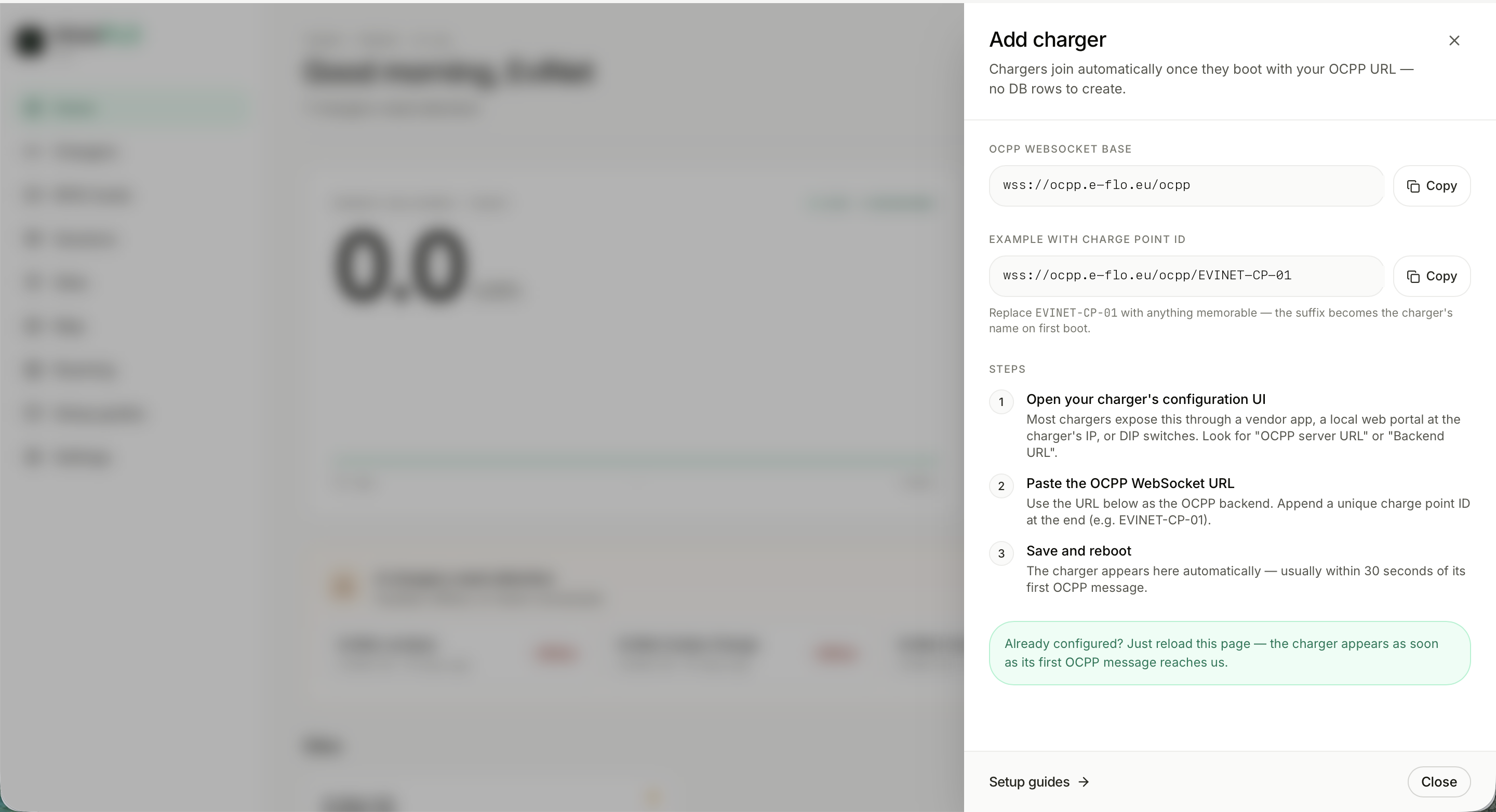
The endpoint, with the per-charger ID pattern. Chargers already configured appear the moment their first message reaches us. Operator console with demonstration data.
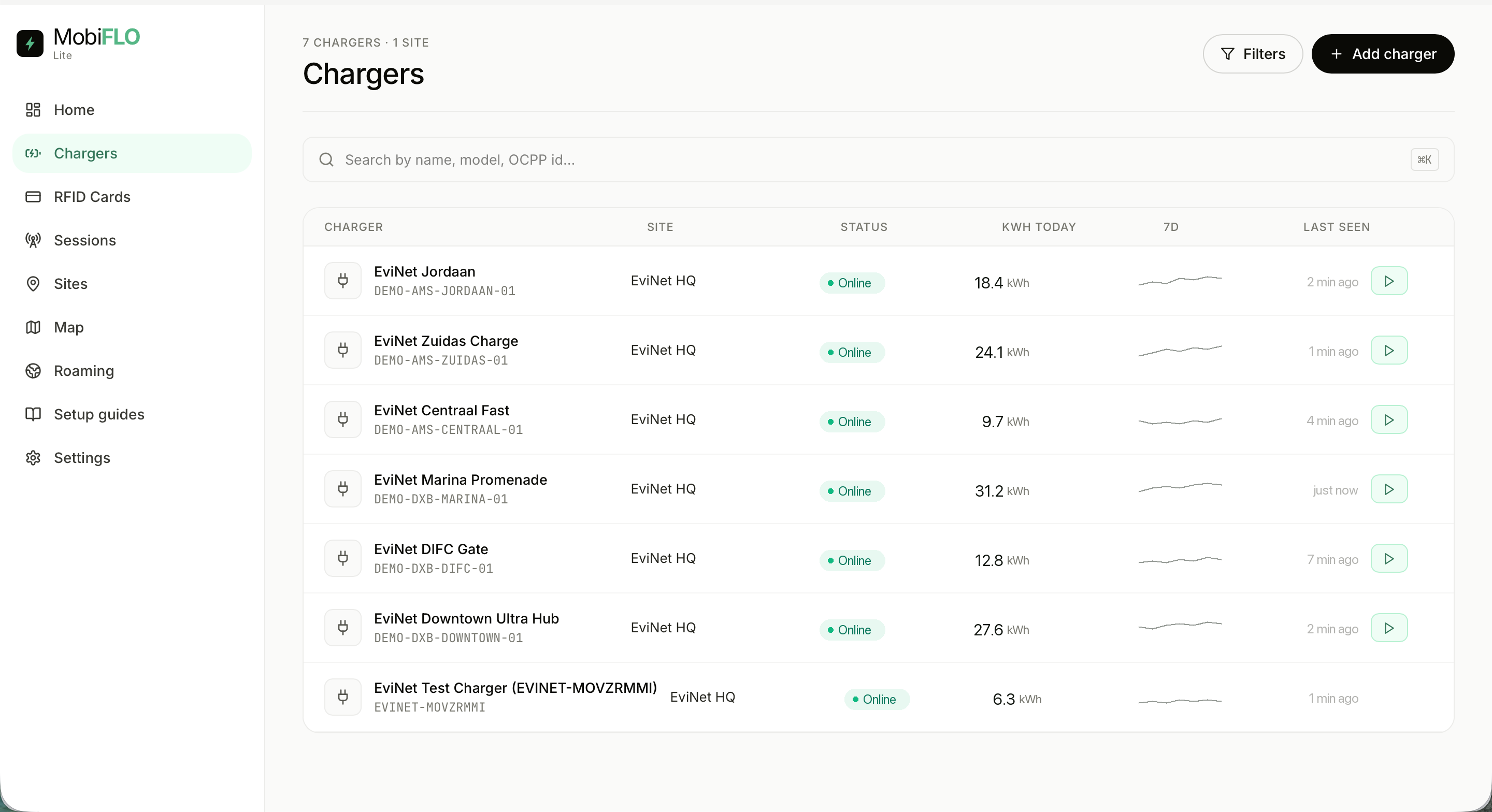
Once across, every unit sits in one list — status, energy today, seven-day trend, last seen — searchable by name, model or OCPP ID, whatever brand it is. Operator console with demonstration data.
Operating chargers is one half. If you also issue cards or accounts to drivers, those come across as well — this is a full transfer, not a hardware move.
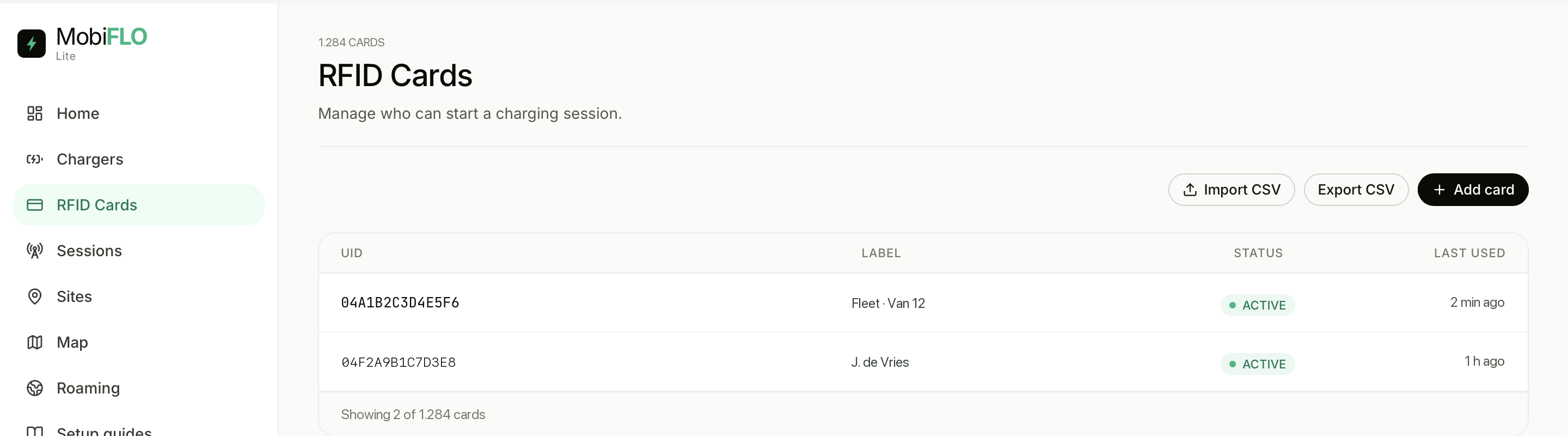
The card register imports and exports as CSV, so an entire book of cards moves in one file. Operator console with demonstration data.
| What they charge today | What happens with us |
|---|---|
| Per user or per card, monthly | dropped Treated exactly like a per-socket fee — it disappears, on the same terms as the chargers. |
| A percentage of transactions | inherited We take it over at the rate you pay today. It is a cost of running settlement, not a licence, so we do not pretend it vanishes. |
| Per transaction, fixed | inherited Same reasoning — carried over at your existing rate. |
Cards keep working: tokens are imported, so drivers need no new card and need to be told nothing. Export your current register, send it over, and we will tell you exactly which of your fees fall away and which carry across before you commit to anything.
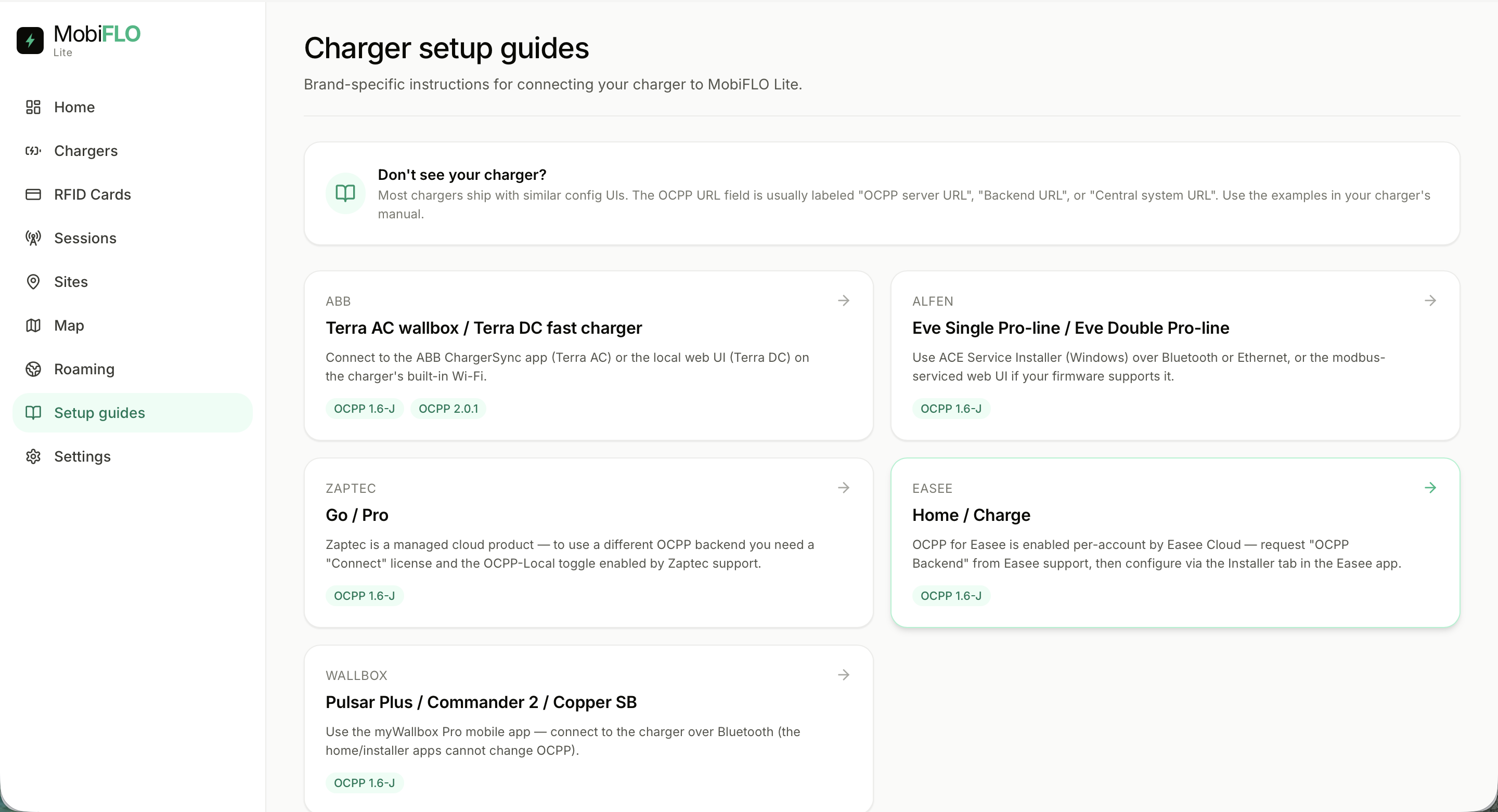
Brand-specific guides are built into the console, including the awkward ones. Operator console with demonstration data.
| Brand | How you reach the OCPP field |
|---|---|
| ABB Terra AC / Terra DC | ChargerSync app on Terra AC, or the local web UI on Terra DC, over the charger's own Wi-Fi. OCPP 1.6-J and 2.0.1. |
| Alfen Eve Single / Double Pro-line | ACE Service Installer over Bluetooth or Ethernet, or the serviced web UI if your firmware supports it. |
| Wallbox Pulsar Plus / Commander 2 / Copper SB | myWallbox Pro app over Bluetooth. The home and installer apps cannot change OCPP. |
| Zaptec Go / Pro | needs the vendor A managed cloud product. You need a "Connect" licence and Zaptec support must enable the OCPP-Local toggle. |
| Easee Home / Charge | needs the vendor OCPP is enabled per account by Easee Cloud. Request "OCPP Backend" from their support, then configure via the Installer tab. |
Not on the list? Most chargers ship with a similar config screen — check the manual for any of those three field names.
Measured from installation. Older units drift out of firmware support with their own manufacturer, which means an OCPP quirk we cannot fix and a support burden that lands on us. We would rather say no up front than take on a fleet we cannot keep running. Older chargers can still connect — they are just outside the free migration and carry standard per-socket pricing.
Pointing each charger at the new URL is your side of the work. It has to be — the config sits behind your credentials, your vendor accounts and, on some sites, a physical visit. We give you the URL, the per-brand guide and someone on the phone while you do the first few. Everything after that message arrives is ours.
Two conditions: the chargers you bring have to be recent enough for us to support, and you commit to e-flo hardware in proportion to the fleet we take on.
Tied to the size of the fleet we take on, because that is what drives our cost:
| Chargers you bring | e-flo chargers you commit to |
|---|---|
| Up to 500 | 250 — the floor |
| 501 and above | 50% of the number brought across |
The two rules meet exactly at 501, so the number never jumps: 400 chargers → 250. 500 → 250. 800 → 400. 2.000 → 1.000.
Term and delivery schedule are agreed in writing. The commitment is hardware you were going to buy from somebody.
Chargers must be under two years old, measured from installation.
This one is self-interest and we will say so: older units drift out of firmware support with their own manufacturer, which means OCPP behaviour nobody can fix and a support burden that lands on us and then on your drivers. We would rather decline a fleet than run one we cannot keep up.
Older chargers can still be connected — they simply sit outside this offer and carry standard per-socket pricing.
"Free" here means no per-socket licence — not that the platform costs nothing. Running a CPMS means hosting, monitoring, roaming connections, support and an uptime commitment, and that is charged as a single SLA rather than as a tax on each charge point.
Our published operator programme rate is € 2.600 per month for the first three years and € 3.800 per month thereafter, covering the software SLA, hosting and support for the whole estate. That is the only recurring fee we charge — it does not rise when you add chargers, and there is never a percentage of what you sell.
The SLA for a migration is set against the size and shape of your fleet and agreed in writing before anything moves. The figures above are the published programme rate, not an automatic quote.
| Charge point | Per-socket fee |
|---|---|
| e-flo hardware — bought from us, whenever | € 0 for its first 30 months from delivery, then € 3 per charge point per month. Every new unit starts its own 30 months. |
| Migrated hardware — any other brand you bring across | € 0 for the first 30 months, then € 3 per charge point per month. |
Why the clock: electronics age — firmware moves on, OCPP quirks appear, and more of the monitoring and fault-handling falls to the platform. Thirty months covers the window in which a charge point runs nearly support-free; the € 3 thereafter covers the extra attention an older unit needs. A replacement charger starts a fresh 30 months at € 0, so the fee quietly rewards keeping the estate current.
Every charge point runs free for its first 30 months — e-flo hardware from delivery, migrated hardware from the day it moves across — and € 3 per charge point per month after that, because older units take more monitoring and fault-handling. A replacement charger starts a fresh 30 months at € 0. Separately there is a single SLA covering hosting, roaming and support: the published operator programme rate is € 2.600 per month for the first three years and € 3.800 thereafter, with your own agreed in writing against the size of your fleet. There is never a percentage of what you sell.
250, or half the number you bring across if that is more. The two rules meet at 501 chargers, so the requirement never jumps: bring 400 and you commit to 250; bring 800 and you commit to 400; bring 2.000 and you commit to 1.000. Term and delivery schedule are agreed in writing.
Anything that speaks OCPP 1.6J or OCPP 2.0.1, which is most commercial hardware sold in Europe in the last decade — Alfen, Zaptec, Wallbox, Easee, Garo, ABB and others. Chargers tied to a closed proprietary cloud with no OCPP mode cannot be migrated to any platform, ours included.
For each charger it is a change to the OCPP backend URL, which on most fleets is done remotely and takes minutes. Paste the URL, append a charge point ID, save and reboot — the charger appears in the console on its own, usually within 30 seconds of its first OCPP message. Sessions in progress finish normally.
Yes. Free migration covers charge points under two years old, measured from installation. Beyond that, units drift out of their own manufacturer's firmware support, which means OCPP behaviour we cannot fix and a support burden we would be taking on blind. Older chargers can still be connected — they simply fall outside the free offer and carry standard per-socket pricing.
You do. The OCPP endpoint setting sits behind your vendor accounts and your credentials, and on some sites behind a locked cabinet, so it is not something we can reach. We provide the WebSocket URL, brand-specific guides for ABB, Alfen, Zaptec, Easee and Wallbox, and someone on the phone while you do the first few. Everything from the moment that first message arrives is ours.
Yes. The operator console and the driver app carry your name, your colours and your domain. Your customer never sees e-flo unless you want them to.
They keep working. Card tokens are imported as part of the migration, so drivers do not need new cards and do not need to be told anything.
You buy chargers from us instead of from somebody else. That is genuinely the whole thing. We sell hardware and give the software away; our competitors sell software and are indifferent about hardware. If our chargers are not good enough to win your business on their own merits, this offer does not save us.
No. Most resellers start with one site to see how it goes, then move the rest over a few weeks. The commitment is on hardware, not on migration speed.
Then this is probably not for you, and we would rather sell you hardware on its own merits. Our chargers work with any OCPP backend — that is the point of them.
New to operating chargers commercially? Start with the free 15-page guide How to start a charging network — economics, grid, hardware, software and a 90-day plan. Running chargers for your own staff instead? Workplace charging — the employer's guide.